

Wireless & Radio Broadband. Wireless Wi-fi Internet Networks |
 |
|
A wireless (Wi-Fi) WLAN
is a wire (cable) free local area network, extended on a limited area,
depending upon the equipments that are being used and their power,
which allows data transfer and internet using radio waves.
Eliminating all types of cables, enables a higher network elasticity/flexibility, which can be configured in an optimum way by professionals to satisfy the needs of each end-user. It's good to know that the equipments are not efficient without being correlated with the professionalism of the installation and configuration team. This is the reason why so many clients contact us after being disappointed by the low efficiency of their actual terrestrial or wireless network, although they installed the latest generation equipments with high overall costs. Our team designs internet networks or wireless distribution networks (Wi-Fi) using strict measurements based on site-surveys, absolutely independent for each client or ISP. We also implement already configured wireless and radio networks and solutions for corporations with coverages of 3 Km, 5 Km or 20 Km radius, like the iDirect solutions, that have already implemented the administration interface for 200 end users. These solutions are generally applicable to large societies, industrial companies that have large surfaces to cover with direct visibility, and who need vital mobile communications for their employees. These solutions are preconfigured for a large, but also a constant number of users, so they are not applicable for a growing ISP, or an ISP in transition, or networks having future projects, because there are hardware limitations. For ISP clients, or for networks in transition with a large surface to cover and a growing number of users, a principal network is created, which later develops by adding additional equipments and bridges, the structure being adapted exactly for the future network. It's good to know that Wireless Fidelity (Wi-Fi) represents a category of products compatible with WLAN standards based on IEEE 802.11. The new standards that preceded 802.11 specifications, like 802.16 (WiMAX), are part of the actual networks and offer lots of improvements, from larger coverage areas to higher rates of transfer. Generally, Wi-Fi networks can lose due to the wrong
conception of the network, improper equipment, too far distances or
natural phenomena (rain, snow, fog). Applicable laws limit the
standards and power of the equipment and in the same time the spectrum
for applicable frequency, reason for differences between terrestrial networks and a wireless radio network are multiple, the wireless networks bringing many benefits: - Unlike other radio wave systems or networks, Wi-Fi
uses a radio frequency spectrum that doesn't need a license, so the
user doesn't need approval for utilization. The conclusion is that a performant wireless network is based on high quality equipments and the most important... specialized technicians in radio transmissions to implement it. |
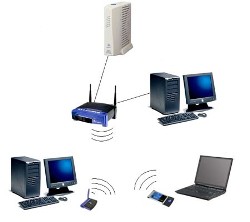 conceiving the network with regard to the
parameters imposed by low, represents a great challenge for our
specialists.
conceiving the network with regard to the
parameters imposed by low, represents a great challenge for our
specialists.| For more information or details about the wireless Internet systems, or Wi-Fi networks, please Contact us |
Lamit Company
- Two
way Satellite Internet
© Copyright 2004-2005. All rights Reserved
© Copyright 2004-2005. All rights Reserved